AdvisorFlow is a product built and owned by Zespida Technologies. It is not client work, and every record in it is fictional. It shows how we deliver client projects.
Context
AdvisorFlow is for financial advisory teams that manage client households rather than single contacts: a family, its members, the advice opportunities in progress and the follow-ups each one needs. When that work lives across spreadsheets, inboxes and a generic CRM, follow-ups slip when an opportunity moves forward and nobody can say who changed what.
AdvisorFlow has three parts: a Salesforce Sales Cloud org that holds the CRM data and automation, an API, and a web app. The API and Salesforce metadata share one repository and the web app has its own, each with its own pipeline.
Challenge
A CRM in a regulated setting has to do more than store contacts. Every integration needs its own identity and only the access it needs, credentials cannot live in code, and every change to the org has to be tested before it reaches production.
Solution
- Salesforce org. Households are Accounts with their own record type, and advice work is an Advisory Engagement opportunity with its own sales process. A record-triggered Flow creates a follow-up task when an opportunity reaches Qualification and a review task at Proposal Presented, without creating duplicates. A Lightning Web Component on the opportunity page lists those follow-ups through an Apex controller that runs in user mode, so it respects sharing and field-level security.
- API. An ASP.NET Core API on .NET 10 is the only component that talks to Salesforce. It serves households, members, the opportunity pipeline, activities and a dashboard over a versioned OpenAPI contract, and it enforces the business rules, such as one primary member per household and an opportunity stage that can move forward but only one step back.
- Web app. An Angular app is the advisor's screen: households and members, the pipeline, open and overdue follow-ups, and a dashboard with a weighted forecast and win rate. Anyone can browse the demo, and advisors sign in with Microsoft to create and edit records.
Architecture
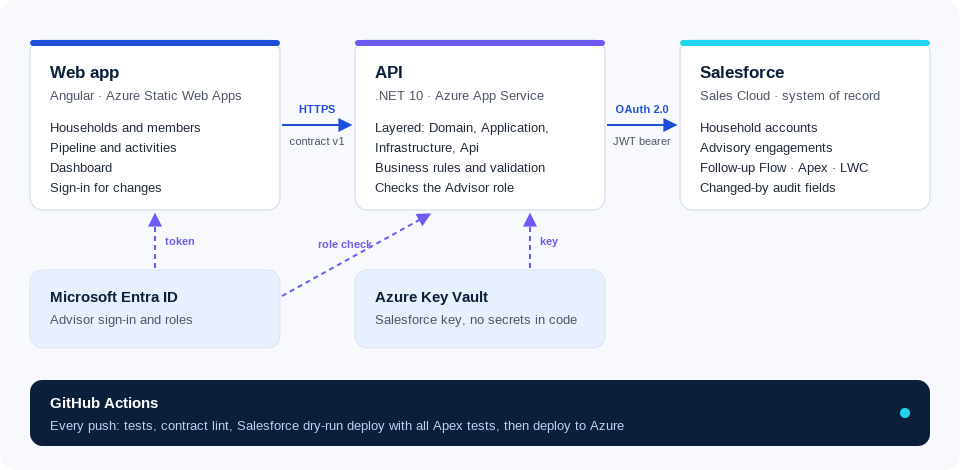
The web app calls the API over HTTPS using the published contract, and the API reaches Salesforce as a dedicated integration user with the OAuth 2.0 JWT bearer flow. Advisors get a token from Microsoft Entra ID, and the API checks it for the Advisor role before allowing any change. The Salesforce signing key lives in Azure Key Vault.
Security approach
- Sign-in through Microsoft Entra ID with OAuth 2.0. Reading is open for the demo, and all six create and update endpoints require the Advisor role.
- Least-privilege access: the integration user can work only with household accounts and advisory engagements, and the CI user can validate deployments but cannot read records.
- Secrets stored in Azure Key Vault, never in source code or pipeline files.
- Audit trails on sensitive changes. Every create and update records the signed-in advisor in a changed-by field on the Salesforce record and in the API log.
- Errors return standard problem details without leaking Salesforce internals, and the API documentation page is turned off in production.
Testing and CI
Every push runs the automated test suite in GitHub Actions. Salesforce metadata is validated against the org in CI with a dry-run deployment that also runs every Apex test, and the API deploys to Azure only after that passes. The web app deploys through its own pipeline.
- 278 .NET tests: unit, HTTP integration, contract tests that compare responses with the OpenAPI file, and architecture tests that enforce the layer rules.
- 14 Apex tests in Salesforce, including a 200-record bulk insert through the Flow.
- 5 Jest tests for the Lightning Web Component and 43 Angular unit tests.
- Checks for vulnerable packages and an OpenAPI lint on every run.
Results
- More than 300 automated tests run on every change, across .NET, Apex, Lightning Web Components and Angular.
- A full API pipeline, from push to tests, Salesforce validation and deployment, takes about two minutes.
- No secrets in source code: Salesforce and CI credentials live in Azure Key Vault and GitHub secrets.
- 16 architecture decisions recorded, so every design choice has a written reason.
- Verified live end to end: an advisor signs in, moves an opportunity forward, the Flow creates the follow-up in Salesforce, and the record shows who made the change.